
Running ads on Amazon isn’t difficult, but generating a sustainable profit is the real challenge. Many sellers discover too late that their ACOS (Advertising Cost of Sales) has ballooned, leaving their profit margins negligible.
The primary culprit? A lack of proper understanding regarding Amazon keyword match types. If you select the incorrect match type, Amazon will display your ad to “window shoppers” rather than high-intent buyers.
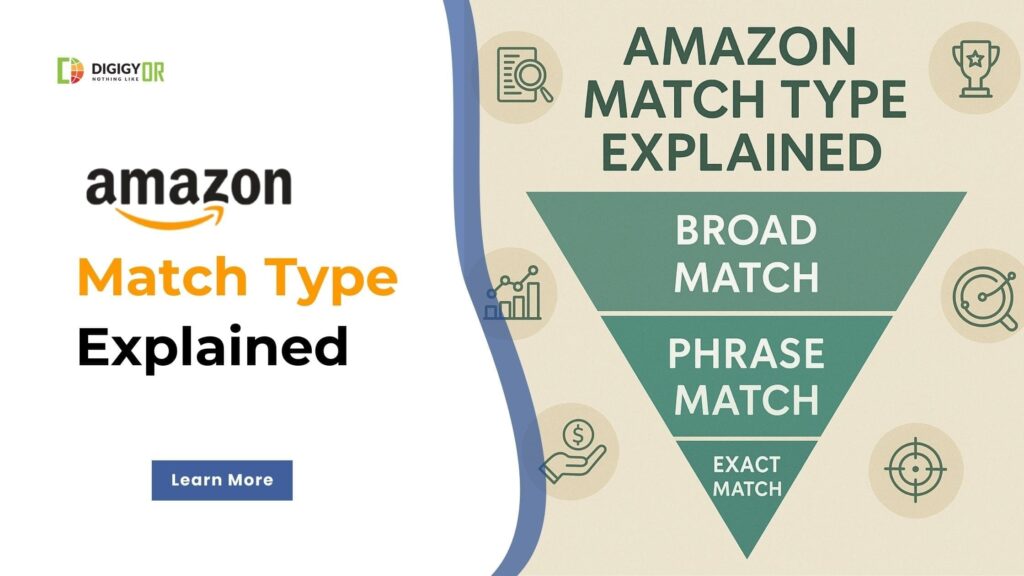
To master your Amazon PPC (Pay-Per-Click) campaigns, you must understand how to leverage Broad, Phrase, and Exact match types as part of a cohesive growth strategy.
The Three Amazon Match Types
1. Broad Match (Widest Reach)
Broad match offers the widest reach. It is designed to cast a large net to identify how customers are searching for products like yours.
How it works: Your ad appears for your keyword, its synonyms, abbreviations, and related searches.
Update on Close Variants: Amazon now includes “close variants” (plurals and misspellings) in all match types.
Example: If you bid on “leather wallet,” your ad might show for “leather purse,” “men’s wallet,” or even “brown pocketbook.”
| Pros | Cons |
| Maximizes brand visibility | High risk of “budget leakage” |
| Ideal for new keyword discovery | Lowest conversion rate (CVR) |
2. Phrase Match (Moderate Reach)
Phrase match targets queries that contain your exact phrase (or close variants) in the specific order you’ve set, but allows for words to appear before or after the phrase.
How it works: It keeps the “intent” of the keyword while allowing for natural long-tail modifiers.
Example: For the keyword “leather wallet,” your ad shows for “black leather wallet” or “leather wallet for men.” It will not show for “leather travel bag.”
# Expert Tip: Phrase match type is always the best choice to get the best out of the Amazon PPC campaign. Running ads with phrase match type ensures higher conversion and broader reach.
| Pros | Cons |
| Achieving greater reach to the target audience | Less reach than broad type (but more targeted) |
| Potential clicks, high conversion |
3. Exact Match (Highest Precision)
The name exactly explains the match type. Exact match targeting refers to targeting specific keywords in Amazon PPC campaigns. Exact match targeting is a kind of filtered targeting that targets the core audience. Your ad will be displayed to the customers who used the exact query to search for the product.
Here, we will understand the “Exact Match Type” with an example.
David is a seller who sells leather wallets on Amazon. He wants to advertise the product. To target the exact match, he will use “Leather wallets” as an exact match type. Here, Amazon will display David’s ad on exact queries, its singular, plural, and misspellings.
E.g., “Leather wallets”, “leather wallet”, “leather hallets”, etc.
Pros:
- You will target the core audience. You will get more qualified clicks.
- Chances of conversion are higher.
Cons:
- Your audience reach will be limited.
- You are losing the audience with broader queries like ” leather wallets for gifts”,” leather wallets for men”, etc.
Amazon Broad vs. Phrase vs. Exact Match: Comparison Table
Here is a quick comparison –
| Feature | Broad Match | Phrase Match | Exact Match |
| Reach/Exposure | Maximum | Moderate | Minimum |
| Search Query Rule | Keyword terms in any order; includes synonyms and related terms. | Exact phrase in the same order; can have words before/after. | Only the specific keyword or very close variations. |
| Example | Men’s purse, brown pocketbook, wallet for a gift | Black leather wallet, leather wallet for men | Leather wallet, leather wallets |
| Precision | Low (High risk of irrelevant clicks) | Medium | High (High intent shoppers) |
| Typical ACOS | Higher (28%–38% average) | Moderate (20%–30% average) | Lowest (12%–22% average) |
| Typical CPC | Lowest | Medium | Highest |
Which Match Type is Best for Amazon Advertising?
Each match type has its pros and cons as we discussed above. However,
# Phrase Match Type: If you are an established or old seller, you should go for the phrase match type. It will help you gain more sales and stay ahead of the competition.
# Broad Match Type: If you are a new seller, use a broad campaign match type for 15-30 days. This will help you interact with new queries that users search for to find products similar to yours. Once you have prepared a list of potential keywords, switch to the phrase match type.
# Exact Match Type: An exact match is ideal for those sellers whose product has a core or a filtered product audience. This way, you can get the best results running the exact match type.
Conclusion: Maximizing Your Amazon PPC ROI
Mastering Amazon advertising requires a strategic balance. Broad match drives visibility, Phrase match offers refined reach, and Exact match secures the sale. To keep your ACOS low, remember to frequently use negative keywords to prune irrelevant traffic from your broad and phrase campaigns.
Ready to scale? Visit digigyor.com/ today for a limited-time free consultation. Our experts will provide a comprehensive Amazon seller account audit and a custom optimization plan to boost your sales.