

Amazon has become the largest online marketplace in the world, attracting shoppers from across the globe. New vendors are joining every day, hoping that their items will be noticed and sales will follow. The truth is, just because you feature your item or are on Amazon, it doesn’t mean you will get sales.
Today’s customers have become very smart and selective. They don’t just look at products; they seek an “experience.” They look at 10 things before clicking the “Buy” button, such as price, pictures, reviews, and the level of their trust in the brand. In this competition, only the seller who understands the psychology of the buyers and other factors will survive.
How People Shop on Amazon
It is essential to understand the behavior of customers on Amazon because, in this case, shopping is fast and organized. In contrast to the offline market, there are no salesmen to describe the product and its benefits; customers in this market rely only on images, descriptions, reviews, and ratings. Therefore, the primary goal of a seller is to demonstrate the perfect quality and details of the product.
Customers browse products on Amazon in mere seconds and compare the price, delivery time, and star ratings of products to make their final purchase. In this fast-paced shopping, sellers must immediately show the advantage and credibility of their products. If the picture of a product is not good or the details are not provided, customers won’t wait for a second and will immediately switch to another competitor.
Types of Consumer Buying Behavior on Amazon
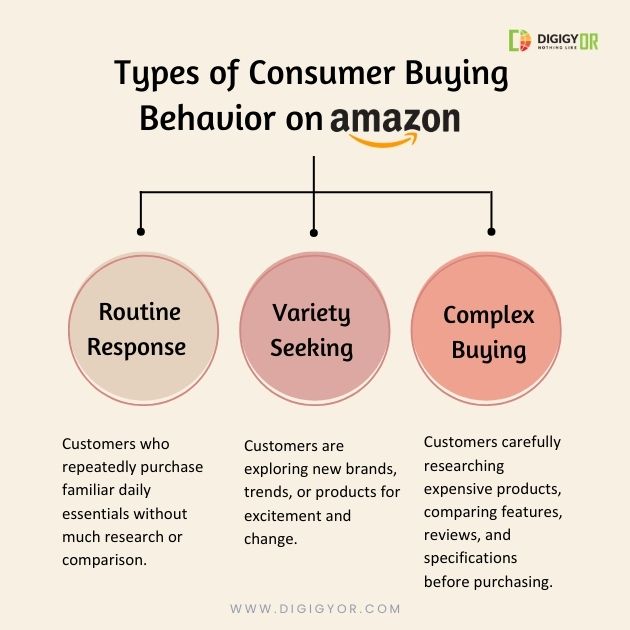
Each Amazon customer has a distinct “Decision Pathway,” and this is what Amazon’s AI algorithm follows. It is very important to understand customers’ buying behavior on the e-commerce platform to increase your product’s visibility on Amazon SEO and improve conversion rates. Some customers click “Buy Now” without giving it a second thought, while others take days asking Rufus AI questions. As a seller, it is very important to understand your type of customer so that you can optimize your product listings and A+ content accordingly.
1. Routine Response (Daily Essentials)
These are customers who come to buy daily essentials like soap, snacks, or groceries. Their buying behavior is entirely automatic, such as buying their favorite brand without giving it a second thought. They don’t spend much time comparing prices. They just want fast shipping and the ability to “Subscribe & Save.” If your product is a daily essential, you can build loyal customers and generate sales from this group.
2. Variety Seeking (Lifestyle and Trends)
Customers in this group are tired of their previous brands and are looking for something new and exciting, such as new fashion, new trends, or new trendy gadgets. To appeal to them, your product listings need to have A+ content and an interesting brand story. They have a short attention span, so your visuals (high-quality images and videos) need to be strong enough to click and convert immediately from the Amazon Inspire page.
3. Complex Buying (High-Value Items)
In the case of high-value products like laptops, DSLR cameras, or high-end appliances, the tab buyer becomes very cautious. These buyers read the reviews written by the AI system very carefully and compare the technical specifications of the product with those of its competitors. They want to make sure that their hard-earned money is going into the right investment. So, your Amazon product listing needs to be as knowledgeable as an expert, dispelling all doubts and providing a high feeling of confidence.
How Scarcity, Urgency, and Limited Deals Influence Buying Decisions
The strongest drivers of “Buy Now” clicks on Amazon are psychological triggers. When consumers believe a product will be out of stock or an offer will end, they tend to make quick decisions.
1. Fear of Scarcity
Seeing the message “Only 3 left in stock” makes consumers feel they will miss their chance if they don’t purchase immediately. This trigger automatically increases the conversion rate.
2. Urgency
“Lightning deals” or “countdown timers” (for example, a deal that will expire in 2:00 minutes) do not give the customer time for comparison. They fall prey to FOMO (fear of missing out) and make purchases immediately.
3. Temporary Deals
Seasonal or exclusive offers are limited-time promotions, meaning that consumers cannot postpone their purchases.
Warning: These triggers will be effective only if they are truthful. False stock levels or timers can erode customer trust and damage brand reputation.
Factors That Influence Purchase Decisions on Amazon
People on Amazon do not just order because it is cheap; they do a complete check-up. They are not just concerned about the price; they are concerned about the visibility of the product, the trust of the brand, and the reviews. Suggestions from AI assistants, such as Rufus, also play an important part in it. If you want to turn browsers into loyal customers, you have to modify your sales approach according to market trends.
1. Price
The most important factor that influences the purchasing decision on Amazon is the price. When a user considers purchasing a product, they first check their budget. Amazon knows the importance of pricing, too.
You often see the Amazon badge “Best Price” on products appearing in the search results. The best price acknowledges to the user that the particular product is available for the lowest price on Amazon to buy. So, a brand needs to check and compare the pricing of the competitors on the Amazon portal and keep it nearby to make sure you do not lose sales.
Although price is the main factor that users pay attention to, it doesn’t mean that having a low price guarantees good sales on Amazon. You also need to make your listing appealing. This leads us to our second factor that influences customers’ purchasing decisions, which is interactive visuals.
2. Interactive Product Listing
Use all the features Amazon offers while creating a listing on Amazon that includes five bullet points, a product description, and 10 images, including 1 video. Do add your product to the right category and fill out as many attributes as you can to ensure your listing gets good visibility on the Amazon search pages.
3. Reviews and ratings
Most users look for product reviews and ratings on Amazon before making a purchase decision. They read the reviews and ratings of the products and compare which one is best from the list Amazon suggested.
Also, people often look for blogs on the internet (Google) with queries like “Best grinders online” followed by the current year or a feature, etc. They read the influencers and blog suggestions and then decide to buy a particular product.
4. Brand Reputation
Brand reputation is a key factor that influences a decision while buying online. So, it is necessary to focus on brand identity building while selling on Amazon.
You should maintain a good brand reputation by delivering orders on time and providing good customer support service (if you are doing FBM). Add a brand story, and design Amazon A+ content to present more details about the product, such as technical specifications, features, and benefits.
Link with some influencers and get your product endorsed online on their social channels and blogs. This way, users will recognize your brand and help you build a strong reputation.
Conclusion
Before purchasing on Amazon, customers consider a few factors: price, product information, reviews, and quality of the brand. It is not sufficient to be cheap; quality images and information are sufficient to impress. Positive ratings and reviews will do the trick, as they help to build trust. To remain at the top of Amazon, sellers need to ensure that these factors are perfect.
Read More: How to Build Your Brand on Amazon